
Beyond the Title
Women, Motherhood, and the Career Nobody Talks About
Over the past nine blogs, I’ve spent a lot of time writing about leadership, organizational culture, systems, and the lessons I’ve learned navigating professional spaces as a Pacific Island woman.
But if I’m being honest, that’s only part of the story.
Because outside of the meetings, projects, leadership roles, and professional titles, there’s another reality that many women are carrying quietly every single day. The part that rarely makes it onto a résumé or LinkedIn profile. The mental load. The constant balancing act. The pressure of trying to succeed professionally while also showing up fully for your children, your family, your relationships, and everyone else depending on you.
I know that reality deeply.
I’m a consultant, founder, and leader, but I’m also a mother, a wife, a daughter, and a woman trying to navigate all of those identities at the same time. Some days I feel like I’m managing it well. Other days I feel completely stretched thin and wondering whether I’m giving enough to any part of my life.
And the more conversations I’ve had with other women across Hawaiʻi and the Pacific, the more I’ve realized how many of us are quietly carrying those same thoughts while pretending we’re fine. That realization is what inspired this next series.
Beyond the Title: Women, Motherhood, and the Career Nobody Talks About will be more personal than anything I’ve written before. Less polished. Less focused on leadership frameworks and more focused on the realities behind them.
I’ll be sharing my own experiences, but I’ll also be sitting down with Pacific Islander and Native Hawaiian women, working mothers, founders, professionals, and leaders who are willing to speak honestly about the realities that exist outside the title.
Not the curated version people post online. The real one.
The one that exists after the meetings end, after the kids go to sleep, and during the quiet moments where women wonder whether they’re doing enough in any area of their lives.
Because I think there’s something powerful about women telling the truth about their experiences. Not just the successful moments, but the complicated ones too. And sometimes hearing another woman say, “I’ve felt that too,” is enough to remind you that you were never carrying it alone in the first place.
I hope you’ll join me for this next chapter.
Their Limits Were Never My Ceiling
There’s a particular experience that many leaders know, even if we don’t always talk about it openly. It’s the experience of walking into a room and feeling like people have already decided who you are before you’ve had the chance to say a single word.
Not because of your work or your experience, but because of how young you look, whether you fit someone’s idea of leadership, or simply because you don’t look like the people they’re used to listening to.
I knew that feeling early in my career. As a young Palauan woman stepping into leadership roles in government, I was often the youngest person in the room and sometimes the only woman. There were spaces where I could feel the underestimation before I could fully explain it to myself. Conversations would move around you instead of through you. You’d share an idea, and five minutes later someone else would repeat it and suddenly it carried more weight. And there was always this subtle surprise when your work turned out exactly the way it needed to.
What I didn’t realize at the time was how easy it is to slowly absorb other people’s doubt and turn it inward on yourself. You start overthinking everything. You over-prepare because you feel like you need to earn credibility before you’ve even opened your mouth. You explain yourself too much. You second-guess your instincts, even when they’ve already proven themselves over and over again.
And honestly, that kind of pressure wears on you after a while. Not because of one major moment, but because of the accumulation of smaller ones that slowly make you question whether you’re imagining things or whether it’s actually happening.
For me, the shift wasn’t dramatic. There wasn’t one defining moment where suddenly I became confident and stopped caring what people thought. It was more gradual than that. Over time, I started realizing that a lot of the doubt I was feeling from other people had very little to do with me and a lot more to do with the limits of what they had been taught to recognize as leadership.
Once I understood that, something changed in me.
Not in a loud or obvious way. I still noticed when people underestimated me. I still walked into rooms where assumptions were already being made. But I stopped carrying the responsibility of changing everyone’s mind before I could trust my own voice. I stopped shrinking myself to fit spaces that were never really designed with people like me in mind in the first place.
And somewhere along the way, I realized that clarity mattered more than confidence. Confidence comes and goes depending on the situation, but clarity stays with you. Clarity reminds you who you are even when other people don’t fully see it yet.
Looking back across this entire leadership series, I realize that’s really what I’ve been writing about the whole time.
Not titles. Not authority. Not leadership theories. People.
The leaders who shaped me most were not the loudest people in the room or the people most concerned with power. They were the people who made others feel seen, trusted, and capable of becoming more than they thought they could be.
Minister Sadang taught me that humility can carry more influence than ego ever will. President Remengesau showed me what steady leadership looks like under pressure. And other mentors throughout my life reminded me that listening is not weakness. It’s respect. People will go much farther for leaders who make them feel valued than for leaders who simply want to be obeyed.
Throughout this series, I wrote a lot about systems, leadership, organizational culture, and capacity building. But underneath all of it was a much simpler lesson that I think matters more than any framework or strategy:
Be a good person. Help others become their best. Most of the rest tends to follow from there.
That belief is also the foundation of why I started WeRise.
At its core, WeRise was built around the idea that organizations are only as strong as the people inside them, and people do their best work when they feel trusted, supported, and genuinely valued. Creating that kind of environment takes intentional leadership. It takes leaders who understand that their role is not to be the smartest person in the room, but to create the conditions for other people to thrive.
That is what servant leadership has come to mean to me. Not as a concept people put into presentations or mission statements, but as something you practice daily in the way you treat people, support people, and lead people.
And maybe that’s the biggest lesson I’ve learned through all of this: Other people’s limits were never meant to become my ceiling.
Neither are yours.
Their limits were never my ceiling.
Leadership That Speaks for Itself
I’ve shared before that I’ve worked alongside many leaders in my career, some of which taught me what to do and others…not so much. But there is one leader who stands apart in my memory, not because of a single lesson or a defining moment, but because of something harder to put into words.
He changed how I understood what it means to lead.
Minister Elbuchel Sadang is not someone who needs an introduction in Palau or even the region. But for those who don’t know him, it’s important to understand the depth of experience he brings — because it gives context to everything that follows.
He brings more than 40 years of experience — across government, non-government, and work spanning Palau, the Pacific region, and beyond. His career has moved across sectors and spaces in a way that very few leaders ever experience. From his early years in higher education at what is now Palau Community College, where he served in leadership roles helping shape future generations, to his time in the Palau National Government, where he held some of the country’s most critical financial and administrative positions.
Over the years, he has served multiple terms as Palau’s Minister of Finance, following leadership roles within the National Treasury, carrying the responsibility of guiding national financial systems, policy decisions, and institutional direction. His work extended beyond Palau, representing the country across regional and international platforms — engaging with organizations such as the Asian Development Bank (ADB) and the Pacific Islands Development Bank (PIDB), and contributing to broader conversations that impact small island economies across the Pacific.
His leadership has also reached into important work in conservation and community-based efforts, including roles that support the protection and stewardship of natural resources — an extension of responsibility that reflects the deep connection between leadership and land in our region. He has played a significant role in shaping and growing organizations such as the Palau Conservation Society and the Micronesia Conservation Trust, both of which continue to serve communities across the Pacific. His work also contributed to advancing major national initiatives, including the development and establishment of the Palau National Marine Sanctuary — one of the largest marine sanctuaries in the world — a landmark effort in ocean conservation that positioned Palau as a global leader in environmental stewardship.
And alongside all of this, he carries the traditional chiefly title of Ngirameketii from Ngaraard State — a role that is not simply ceremonial, but one that reflects cultural responsibility, leadership, and accountability to community and tradition.
I share all of this not to list accomplishments, but to give context. Because what made Minister Sadang remarkable was not any one role, title, or achievement. It was that he carried the same quality of presence, leadership, and responsibility into every single one of them. Leaders with this kind of range are rare. Leaders who carry it with consistency across every space they enter are even rarer. And to carry all of that with humility — that is what truly sets a leader apart.
What It Looked Like When He Walked In
There is a particular kind of presence that some leaders carry. You can’t manufacture it, and you can’t fake it.
When Minister Sadang walked into a room, it got quieter. Not because people were afraid of him — but because they wanted to hear what he was going to say. There was an attentiveness that followed him. People sat up a little straighter. Conversations that had been scattered suddenly had a focal point.
And yet he was never the loudest voice. He was never performing authority.
He simply carried a kind of steadiness that made everyone around him feel like the situation — whatever it was — was manageable. Even when it wasn’t easy. Even when the stakes were high.
I watched him navigate difficult moments — the kind of high-pressure situations that cause other leaders to become reactive, defensive, or distant. He didn’t. He stayed even. And that evenness gave everyone else permission to think clearly instead of just react.
The “We” That Meant Something
I’ve written before about how Minister Sadang spoke in “we” rather than “I.” But I want to say more about what that actually felt like from the inside.
It wasn’t a communication strategy. It wasn’t something he had learned in a leadership seminar. It came from a genuine belief that the work belonged to everyone who contributed to it.
When things went well, he made sure the team knew the success was theirs. When things were difficult, he didn’t disappear behind hierarchy. He was present in the difficulty alongside the people navigating it.
That kind of leadership creates something powerful in the people around you. It creates loyalty — not to a title, but to the work and to each other.
It also created something in me personally. Watching him lead gave me a standard I have held myself to ever since. Not a perfect standard — none of us reach it every day. But a reference point. A reminder of what it looks like when leadership is practiced with both humility and strength at the same time.
What I Carry Forward
The leaders who shape us most are rarely the ones who teach us a framework.
They are the ones who show us, through their presence and their choices, what is actually possible.
Minister Sadang showed me that authority and humility are not opposites. That you can hold a room without dominating it. That the most powerful thing a leader can do is make the people around them feel capable, seen, and part of something that matters.
I still catch myself, in the middle of a difficult meeting, asking: what would he do right now? Not because I’m trying to be him — but because watching him lead gave me a standard I’m still reaching toward.
Leadership is a practice. And some of us are lucky enough, early on, to witness what it looks like when it’s done well.
When the Room Turns Against You
If you read Blog 4 — The Quiet Power of Listening Before Leading — you already know some of this story.
You know I stepped into a government role in Palau young, female, and responsible for work that was never going to be neutral. You know the pressure came. Political noise. Newspapers. The kind of public friction that finds its way into conversations you weren't in.
What I didn't talk about in that post — because the lesson there was about listening — was what it actually took to stay.
There was a morning I picked up a newspaper and saw my name in it. Not in the way you hope for. And I remember sitting with that for a moment — the weight of it — and thinking: the easiest thing right now would be to go quiet. To pull back. To wait for the storm to pass and come out the other side with fewer bruises.
I didn't do that. But I want to be honest — it wasn't because I wasn't tempted.
What Kept Me Standing
What I held onto — the thing that kept me from going quiet — was the people who believed in the work.
Not the people who agreed with every decision. Not the ones cheering from the sidelines. But the colleagues, mentors, and leaders who understood what we were trying to accomplish and why it mattered. People who didn't flinch when things got noisy.
That kind of support is rare. And when you have it, you protect it.
I also came to understand something important about political pressure: most of it is not actually about you.
It is about the change you represent. The disruption to systems that have always worked a certain way. The discomfort of accountability arriving somewhere it hasn't been before.
When you can see the pressure for what it actually is — resistance to change, not a verdict on your character — it becomes something you can stand in without being swept away by it.
Resource recommendation — An amazing book that helped me through some tough times : Dare to Lead: Brave Work. Tough Conversations. Whole Hearts by Brene’ Brown. Amazon Link —→ https://amzn.to/4tvST3W
What Staying in the Room Teaches You
I have worked with leaders across government, higher education, and the nonprofit sector who have faced this same kind of pressure. And the ones who navigate it best share one thing in common:
They don't abandon the work to protect their comfort.
They stay in the room. They stay in the conversation. They keep showing up — even when showing up is hard.
That doesn't mean being reckless. It doesn't mean ignoring the noise entirely. It means having enough clarity about your purpose that the noise doesn't become louder than the mission.
Looking back, those early experiences in Palau shaped something in me that I carry into every engagement at WeRise. When organizations are navigating change, there will always be friction. There will always be moments when the easiest path is also the one that leads backward.
The work of leadership is choosing, again and again, to face forward.
"The pressure wasn't about me. It was about the change I represented."
Additional Resources that has helped me through the years!
The Let Them Theory by Mel Robbins - Amazon Link —> https://amzn.to/3QCu3Rf
The High 5 Habit: Take Control of Your Life with One Simple Habit by Mel Robbins - Amazon Link —> https://amzn.to/4czHzwl
The 7 Habits of Highly Effective People by Stephen R. Covey - Amazon Link —> https://amzn.to/491Qd5L
Why Good Leaders build Systems, not just Teams
There have been moments in my work where the situation seemed simple on the surface.
A task needed to be done. A decision needed to be made. And yet — nothing moved.
I remember sitting in a meeting, actually a lot of meetings where everyone in the room understood what needed to happen next. The team was capable. The leaders were experienced. The work itself wasn’t unclear.
But we were all stuck. Looking at each other. Waiting. Because the person who was supposed to make the decision… didn’t.
In some cases, it was because they were overwhelmed — carrying too many responsibilities, too many decisions, too many expectations. In others, it was something more difficult to name.
The weight of accountability. Because making a decision means owning the outcome. And sometimes, that fear of being wrong — of making the wrong call — can quietly slow everything down. Not just for one person, but for everyone waiting behind them.
At the time, it was easy to feel frustrated. Why wasn’t anything moving? Why were capable people unable to move forward?
In another situation during one of my recent HR Projects on developing a change management strategy, I ran into the same issue. Decisions lingered, and actions were delayed due to inability or lack of accountability for someone to make a decision. This made something very clear for me:
(By the way, one “old school system” I still rely on? Writing things down. Ideas, tasks, quick thoughts—anything that shouldn’t get lost in the noise. If you’re like me and need a place to capture it all, check out our journals in the WeRise STORE.)
"This wasn’t a people problem. It was a systems problem."
There were competent employees. There were capable leaders. But there wasn’t a system in place to support decision-making, clarify roles, or distribute responsibility in a way that allowed work to move forward consistently.
And that realization shifted everything.
The Assumption We Get Wrong
When organizations experience bottlenecks, the default assumption is that something is wrong with the people. That they need more training. More direction. More oversight.
But sometimes, the real issue is that the system itself is unclear, outdated, or incomplete.
In many organizations, those gaps don’t happen overnight. They are the result of policies that haven’t been updated. Processes that were never fully defined. Roles that were designed for a different era of work.
Over time, those gaps compound. Decisions become centralized in a few individuals. Accountability becomes unclear. And the burden of navigating that uncertainty falls on the very people trying to do the work.
What Strong Leadership Actually Requires
This is why strong leadership is not just about building good teams. It is about building systems that allow those teams to succeed.
Clear roles. Defined decision-making authority. Policies that support — not hinder — the work. These are the structures that allow organizations to move forward with confidence. Because when systems are strong, decisions don’t stall in a single moment. They flow.
And when systems are weak, even the most capable teams will struggle to move forward.
This is something we see often in organizations across Hawaiʻi and the Pacific. The solution is not always more people. And it is not always more training.
Sometimes the most important work is stepping back and asking: Do our systems actually support the way we expect our people to work?
Because when systems improve, everything else begins to move with them. And that is where real, lasting change begins.
"Strong teams matter. Strong systems make them work."
RESOURCES AND LINKS!
Here is also a list of resources that has helped me develop systems, and properly use systems to manage my professional and personal life!
Book — Atomic Habits by James Clear - Link to Amazon.
Planning Tools - The Big A## Calendar — I use this to plan out our year (for home and office) — Link to Amazon.
Production Manager and Developer -
iPad Pro - I swear by this…I bring it everywhere — Link to Amazon.
Apple Watch SE3 - I don’t know what I would do without my watch! From workouts to timer, it helps me through my day — Link to Amazon.
Capacity Building Is Not a Workshop
A few years ago, I was working with an organization that was in the middle of a significant change effort. Like many organizations navigating change, the conversation naturally began with training. What workshops should we offer? What professional development could help staff prepare for new expectations?
Workshops are often the first tool organizations reach for when they want to build capacity. And to be clear — they can be incredibly valuable. But during the institutional capacity assessment phase of the project, something important began to surface in conversations with staff.
Many shared that they had already attended numerous workshops over the years. There had been trainings, meetings, and initiatives focused on improving systems and strengthening the organization. Yet despite all of those efforts, many of the same challenges remained.
What staff described wasn’t a lack of knowledge. It was something deeper.
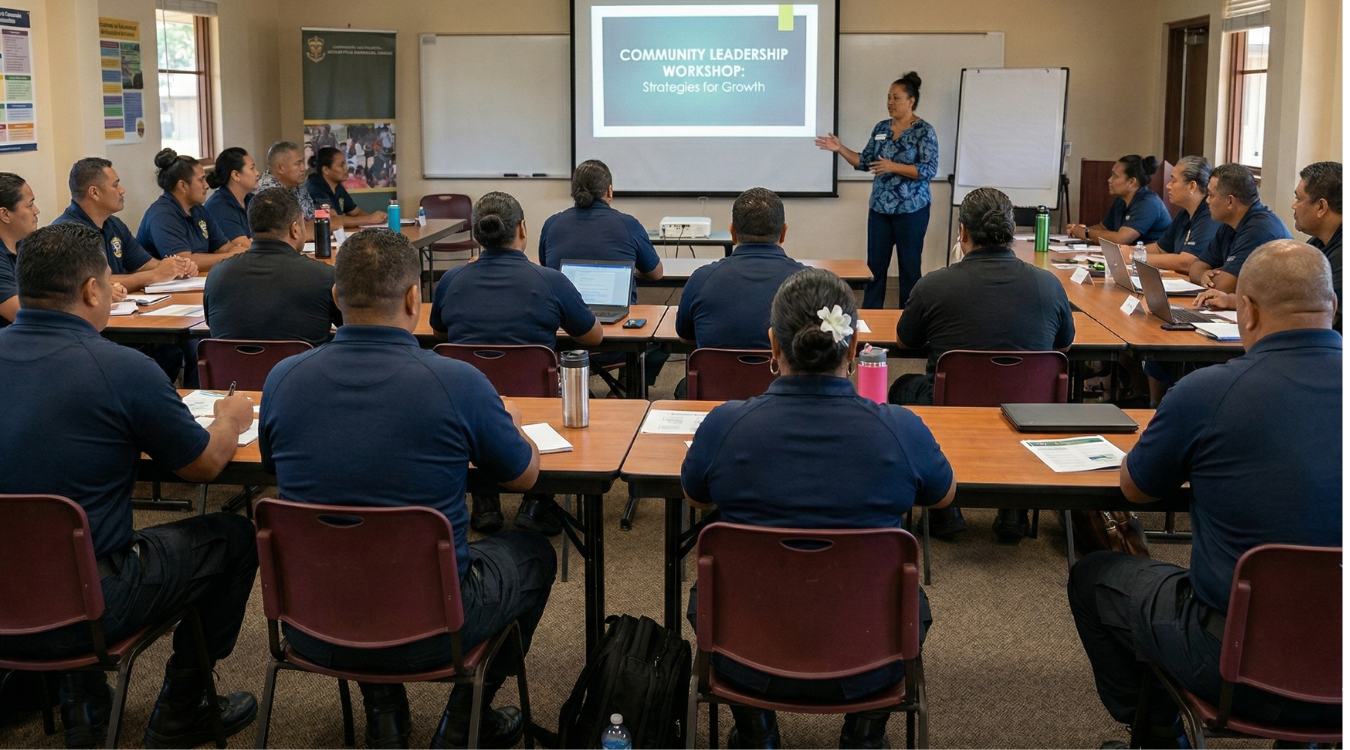
Without consistent follow-through from leadership, alignment with policy, and systems that supported the changes being discussed in those workshops, it was difficult for new ideas to take root. That realization shifted how we approached the change management strategy. Workshops were still important — but they were no longer the center of the solution. Instead, we focused on something more foundational.
First, leadership needed to model the change they hoped to see. When leaders demonstrate new ways of working — through their decisions, their communication, and their expectations — it signals that the change is real. But leadership alone is not enough.
Another key part of the strategy involved identifying internal champions within the organization. These are not always the people with formal titles. Often, they are the colleagues others naturally turn to for guidance — the ones who understand the daily realities of the work and who help their peers navigate new approaches. In many organizations, these trusted voices carry tremendous influence.
When change is supported both by leadership and by respected colleagues across the organization, it becomes far more sustainable. This is something we see often in organizations across Hawaiʻi and the Pacific. Capacity building is most effective when it is supported by leadership alignment, clear policy direction, and people inside the organization who help carry the change forward. Workshops can introduce ideas. But culture shifts when leaders model change and when trusted voices inside the organization help others move forward together.
Capacity building, in other words, is not an event. Capacity building is a commitment. And when organizations invest in that commitment, real transformation becomes possible.
The Quiet Power of Listening Before Leading
Early Days - When I Listened to Hear
Early in my career, I learned one of the most important leadership lessons of my life — not in a classroom or a training, but in the middle of what felt like a political storm.
I had just become the Republic of Palau’s Director of the Bureau of Public Service System under the Ministry of Finance. I was young, and I was female (the complete opposite of my colleagues). I was moving back home after being away, stepping into a role that carried real weight — ensuring the Public Service Act was actually implemented. That meant making hard calls. And in my experience, those kinds of calls tend to split a room right down the middle.
Add a new administration into the mix, and what you get is noise. Political noise. The kind that ends up in newspapers. The kind that — when you're the new person in the room — can feel very personal, very fast.
I'll be honest: I felt attacked. And looking back, I can say with some humor that I was probably the perfect target — young, new, and still figuring out how to hold my ground without losing my footing.
What saved me was a mentor. My direct supervisor.
My position sat under the Ministry of Finance, and the then-Minister of Finance, Elbuchel Sadang, is one of the most formidable leaders I have ever had the privilege of working alongside. (More on him in an upcoming post — he deserves his own blog entirely.)
What Minister Sadang helped me understand was a distinction that changed everything for me:
Listen to understand — not just to hear.
What was being said in those political moments wasn't always what was actually being asked. The noise wasn't always a personal attack, even when it felt like one. Underneath the headlines and the pressure were real concerns, real interests, and real people trying to navigate their own pressures. Once I started listening for that — for the meaning underneath the message — I could respond with clarity instead of defensiveness.
It wasn't easy. And I won't pretend the pressure wasn't real — it was a lot for a young professional to carry. But that shift in how I listened changed how I led.
That experience has stayed with me across every role I've held since — in government, higher education, nonprofits, and now in the work we do at WeRise Consulting Group. When we partner with organizations navigating change, we always start by listening first. Not to validate a plan we've already built, but to genuinely understand the landscape — the concerns, the history, the voices that don't always make it into the room.
In communities across Hawaiʻi and the Pacific, this matters deeply. Trust is not assumed. It is built — slowly, through consistency, through respect, and through the willingness to hear what people are actually saying before deciding what needs to happen.
Lasting change doesn't get delivered to communities. It gets built with them.
And that almost always starts with a leader willing to slow down, set aside the noise, and truly listen.
If you're in the middle of a change effort and want a thought partner who will listen first — we'd love to connect. Visit us at weriseconsultinggroup.com
The Courage to Challenge Systems
Living and working across the Pacific, we don’t really experience the classic four seasons the way people in the continental United States or many Northern Hemisphere countries do. Most of our year moves between wet and… a little less wet.
But even here, this time of year tends to bring a kind of transition—both in our communities and in our organizations.
Before getting into the professional side of things, I want to pause and acknowledge what many communities across Hawai‘i are going through right now. The recent Kona Low storm system has brought significant flooding and damage to parts of the state. For those dealing with cleanup and recovery, our hearts are with you.
If you are looking for ways to help, please consider supporting trusted organizations such as the American Red Cross, Aloha United Way, or other local relief efforts assisting affected communities.
A Planning Window for Organizations
For government agencies and large organizations, March and April tend to be a critical planning window.
Leaders are reviewing budgets, adjusting priorities, and trying to align what they’ve already spent with what they want to accomplish in the coming year.
At the state and local level, this period often overlaps with the end of legislative sessions. Budgets are being finalized, revenue forecasts are being updated, and agencies are making last-minute adjustments.
For organizations working with federal funding or international partners, this is also when planning begins for the next fiscal cycle—often while still managing the current one.
In other words, it’s a busy time of financial review and planning.
But the question is: does this period lead to real improvement, or simply continuation of what already exists?
The Systems We Stop Questioning
One of the most common phrases you hear inside organizations is:
"Why fix something that isn’t broken?"
But over time, many systems do become broken—we’ve just gotten used to them.
When you work inside an organization long enough, inefficiencies start to feel normal. People create workarounds. They adapt. They learn how to operate within systems that may not actually be working very well.
During institutional assessments, we often start to notice patterns like:
The Manual Workaround
Staff maintaining their own “shadow spreadsheets” because the official systems don’t meet the practical needs of the work.
The Approval Paradox
Small purchases requiring multiple layers of approval, while larger operational challenges remain unaddressed because the process to tackle them feels too complicated.
The Legacy Wall
A new employee asks why something is done a certain way, and the answer is simply:
"That’s just how we’ve always done it."
None of these things happen overnight. They build slowly over time.
And eventually, people stop asking whether the system itself needs to change.
Innovation Isn’t Always About Adding More
When people talk about innovation, they often imagine new technology, new platforms, or larger programs.
But in many institutional environments, the most meaningful innovation comes from removing things that no longer serve the organization.
Sometimes improvement comes from asking simple questions:
What can we stop doing?
Which approval layers are slowing down progress without actually improving oversight?
Is this policy still serving our mission today—or is it something we’ve carried forward simply because it’s always been there?
Real innovation often comes from subtraction, not addition.
Why Timing Matters
This spring planning window is one of the few moments in the year when organizations have a natural opportunity to step back and rethink how their systems are structured.
Once budgets are finalized and the fiscal year begins, it becomes much harder to make structural changes. The focus shifts back to implementation and day-to-day operations.
Which means many of the same challenges simply carry forward into the next year.
A Simple Spring Audit
As your team works through planning and budgeting this season, it may be worth pausing to ask a few honest questions:
The Start-Up Test
If we were building this department or program from scratch today, would we design this process the same way?The Friction Point
What is the one policy or process that everyone quietly complains about, but no one has taken the time to revisit?The Resource Question
Are we funding the future—or are we mostly funding the habits we’ve built over time?The Better Way
Sometimes the biggest improvements begin with a conversation that simply asks: “Is there a better way?”
Looking Forward
At WeRise Consulting Group, we work with organizations across Hawai‘i and the Pacific—from our home base in Honolulu to our partners in places like Palau—to step back and rethink how their systems are structured.
The goal isn’t to disrupt systems for the sake of change.
The goal is to ensure that the structures guiding our organizations actually support the people doing the work and the communities they serve.
Because real progress rarely comes from protecting the status quo.
It comes from having the courage to improve it.
Servant Leadership: The Guiding Principles of WeRise
Before I ever read a leadership book, I learned about leadership by watching the people around me growing up in Palau. In our community, those who carried responsibility rarely spoke about themselves - it was always "we," never "I." That way of thinking didn't come from a training or framework, but from the very culture that shaped me.
Long before I knew the term "servant leadership," I was already witnessing it in practice. Leadership was never about power or authority, but about responsibility - the responsibility to care for your people. Anyone who held a leadership role, whether as a chief, community elder, or family matriarch, understood that their role was to serve and uplift those around them. Their purpose was to serve and not be served.
Years later, when I had the privilege of returning home to work in public service in Palau, I saw these principles of servant leadership in action firsthand. As I served under President Tommy E. Remengesau Jr., I was struck by the way he spoke - it was always "we" rather than "I," emphasizing the collective effort and contributions of the team. That small shift in language made a profound difference, as it helped people feel included, empowered, and proud of what they had accomplished together.
Those experiences shaped me deeply and laid the foundation for the work we do at WeRise Consulting Group. Our name itself reflects this ethos of collective rise - we believe that true leadership is not about one person or one voice, but about creating the conditions for teams and communities to grow stronger together.
Whether you're a business leader, nonprofit executive, or public servant, the principles of servant leadership can transform the way you approach your work. It's not about command and control, but about listening, showing up, and serving the greater good. When leaders speak in terms of "we" rather than "I," it lifts people up and inspires them to contribute more fully.
At WeRise, we're passionate about sharing these timeless leadership lessons and helping our clients embed them into their organizations. From coaching and training to custom consulting solutions, we're here to support you in cultivating a culture of servant leadership that empowers your people and propels your mission forward.
Ready to learn more? Reach out and let’s chat - umerang@weriseconsultinggroup.org

The Leaders Who Shaped Me
small steps
When I look back at the leaders who helped shape who I’ve come to be, I don’t think about their titles. I think about their presence.
I’ve spent my career navigating both the private and government sectors. Along the way, I’ve been lucky enough to work with leaders who deeply inspired me—and, if I’m being honest, I’ve worked for others who taught me just as much through their mistakes.
The exceptional ones? They all had a few things in common.
They listened before they led.
They prioritized people, not just metrics.
They were steady. You knew exactly where they stood because they didn't need to dominate a room to influence it.
They understood a truth that many miss: leadership isn't about control. It’s about responsibility.
Then, there was the other side. I’ve also worked in environments where leadership felt like a bottleneck. I’ve seen what happens when "leading" is confused with "controlling"—where every detail is micromanaged, and every decision is hoarded at the top. In those spaces, leaders didn't lift their people; they stood on top of them.
What I’ve learned is this: Leadership isn’t a rank or a title. It’s a practice.
It’s how we show up when the pressure is on. It’s whether we choose to protect our people or just protect ourselves.
Every experience—the wins and the hard lessons—is baked into how I work today. When I partner with organizations through WeRise, I carry those lessons with me. I’m not just there for the systems; I’m there for the humans behind them. I advocate for the leaders who want to be better and for the teams who are tired of struggling in silence.
The leaders who shaped me didn’t always know they were teaching me. But they were.
Their lessons are the reason I show up the way I do: steady, people-first, and completely committed to helping others rise.
Let’s Build a Culture That Lasts
If you’re looking to move beyond "management" and start building a culture where people actually thrive, let’s talk. At WeRise, we help leaders find their footing and teams find their clarity.
Are you ready to change the way your organization shows up? Reach out today, and let’s start the conversation.

Why People Come First
Why do some organizations thrive while others quietly drain their talent? The answer isn't in a spreadsheet—it’s in the people.
In the debut of the Why People Come First series, WeRise Consulting Group founder shares a raw look at the intersection of human nature and high-level leadership. This isn't your typical corporate fluff. It’s a reflection on how intuition, loyalty, and even a bit of "blunt" honesty can transform a workplace.
Whether you’re a leader looking to inspire or a professional seeking more from your environment, this series explores why honoring fundamental human needs is the only real path to growth. From the private sector to government leadership, learn why the "perfect time" to advocate for your team doesn't exist—and why you should start anyway.
People rise, organizations grow. Let’s talk about how to make it happen.
Introducing the WeRise blog series
If you’ve ever wondered why some organizations thrive while others just… survive, the answer almost always comes back to the same thing: people.
Long before WeRise Consulting Group was a reality, I was obsessed with human nature. I wanted to understand why we lead the way we do, why certain environments bring out our best, and why others seem to quietly drain the life out of us.
I’ve taken enough aptitude tests over the years to know I was "supposed" to be in a people-centered field. I’ve often been called sensitive—sometimes a little too sensitive for my own good. I’m not a huge astrology person, but being a Cancer, the descriptions of loyalty, intuition, and a protective instinct always hit close to home. Whether that’s written in the stars or just how I’m wired, I’ve always felt a deep, steady commitment to the people in my orbit.
But let’s be real: I also have a blunt side. I don’t always have a filter.
Age and experience have (mostly) taught me when to hold my tongue and when to speak with intention. Leadership, I’ve realized, is as much about restraint as it is about direction.
My career has been a bit of a journey through both the private and government sectors. I’ve worked for exceptional leaders—the ones who inspire you just by showing up—and I’ve worked for leaders who taught me exactly what not to do. I’m grateful for both.
Throughout it all, the "pull" to help has been constant. If I can’t help financially, I’ll offer an insight. If not an insight, then a word of encouragement. I truly believe we are more alike than we are different; we all share the same fundamental needs. When you honor those needs, people rise. And when people rise, the organization follows.
That belief is the foundation of WeRise.
This blog series, Why People Come First, is a space for the reflections and "gut-check" lessons I’ve gathered along the way. My hope is that somewhere in these stories, you find the clarity or the simple spark of motivation you need to make a move.
Because here’s the truth: It’s never the "perfect" time. It’s almost always the wrong time. But if you don’t start today, you’ll be in the exact same spot tomorrow.
Sometimes, all it takes is one small shift to start something amazing. Let’s start here.